
Build Your Soul Food Restaurant Website
From Sunday dinners to meat-and-three spots, our AI creates warm websites that celebrate soul food traditions.
Soul Food Restaurant Website Examples

AI-designed for Soul Food restaurants
Understanding Soul Food Cuisine
History & Origins
Soul food is a culinary tradition originating from the African American diaspora in the Southern United States, though its roots stretch back to West Africa. It is a cuisine born of necessity, creativity, and resilience, blending African cooking techniques with ingredients available during the era of enslavement and the subsequent distinct Southern agricultural landscape. Staple ingredients like okra, black-eyed peas, yams, and leafy greens have direct lineage to African foodways, while the heavy use of cornmeal and pork reflects the blending of Native American and European influences within the plantation economy. Throughout the 20th century, particularly during the Great Migration, millions of African Americans moved from the rural South to urban centers in the North and West, carrying these family recipes with them. This is when the term 'soul food' gained prominence, particularly during the Black Power movement of the 1960s, serving as a signifier of cultural pride and communal identity. It transformed from simply 'country cooking' into a celebrated cuisine defined by rich flavors, slow-cooking methods, and a distinct sense of heritage. Today, soul food continues to evolve, maintaining its foundation of comfort and community while adapting to modern palates. Whether in a traditional 'meat-and-three' diner or an upscale restaurant reimagining classics, the essence remains the same: food that is seasoned with care, cooked with patience, and meant to feed not just the body, but the spirit.
Regional Styles
While often viewed as a monolith, soul food varies significantly by region. The Lowcountry cuisine of the Gullah Geechee people along the South Carolina and Georgia coast emphasizes seafood, rice dishes like Hoppin' John, and heavy African influences. Inland styles, often referred to as 'Upland South,' focus more heavily on pork, fried chicken, and cornbread. There is also a distinction between 'Down Home' traditional cooking and 'Urban Soul,' found in cities like Chicago and New York, which may incorporate different cuts of meat or sweeter flavor profiles.
Signature Techniques
The soul food kitchen relies on time-intensive techniques that extract maximum flavor from humble ingredients. 'Smothering' is a signature method where meats are pan-fried and then braised in a rich gravy to ensure tenderness. Slow-simmering is essential for greens (collards, mustard, turnip), often cooked for hours with smoked meat (ham hocks or turkey necks) to create the nutrient-rich 'pot likker.' Deep-frying, particularly in cast iron skillets, is the standard for chicken and catfish, while baking is reserved for cornbread, cobblers, and macaroni and cheese, which is strictly a baked custard-style dish in this tradition.
Dining Culture
Soul food dining is inherently communal and centers on the concept of 'Southern Hospitality.' It is food meant to be shared, often served family-style or in generous portions that signal generosity. The 'Sunday Dinner' is a cultural pillar, historically representing a time for church communities and extended families to gather after worship. The atmosphere in a soul food restaurant is typically warm, unhurried, and conversational, where the history of the recipes is often as important as the food itself.
Our AI understands soul food
Family Recipe Storytelling
A dedicated 'About' section layout that allows you to highlight the generational history behind your grandmother's recipes.
Dietary Tradition Indicators
Clear menu icons to distinguish between dishes cooked with pork (traditional) and those using smoked turkey (modern/halal-friendly).
Sunday Dinner Showcase
Special menu formatting to highlight large-format Sunday bundles or rotating weekend-only specials.
Visual Side Dish Selector
Photo-centric layout that lets customers see exactly what 'candied yams' or 'succotash' looks like to encourage adventurous ordering.
Spice & Seasoning Guides
Simple text descriptors to explain flavor profiles (e.g., 'Spicy', 'Smoky', 'Sweet') for international diners unfamiliar with the cuisine.
AI That Understands Soul Food Menus
Our AI automatically recognizes and organizes traditional soul food menu categories.
The Meats
The center of the plate, featuring smothered, fried, or smoked proteins.
Fixins (Sides)
Vegetables and starches like collard greens, mac & cheese, and yams.
From the Skillet
Cornbread, hoe cakes, and biscuits.
Sunday Supper
Large format family meals available on weekends.
Sweet Tooth
Fruit cobblers, pies, and puddings.
Liquid Gold
Sweet tea, lemonade, and red drink.
Upload your menu photos and watch the magic happen
Try It FreeA real restaurant website built with Dinehere
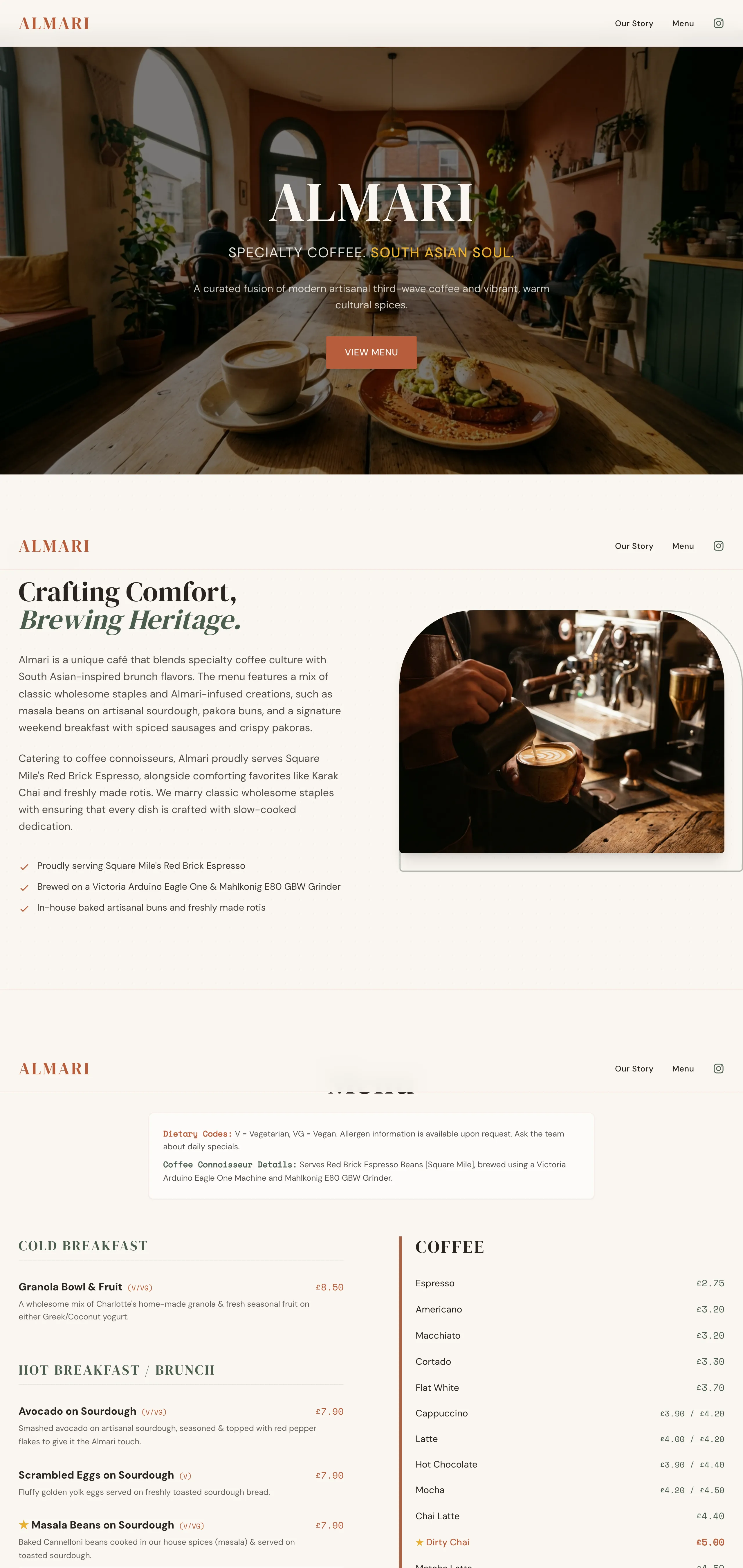
Built from a few menu photos — this is a live site. Take a look.
Tips for Soul Food Restaurant Owners
Tell the Story of the Source
Soul food is narrative-driven. Use your website's 'About' section to mention if a recipe came from your grandmother or a specific region like the Gullah coast. Customers love the authenticity.
Photograph the 'Perfect Bite'
Brown foods like gumbo or smothered chops can be hard to photograph. Instead of a top-down shot of a brown bowl, take a close-up of a spoon lifting the meat and vegetables to show texture and steam.
Clarify Ingredients for Newcomers
In the UK, not everyone knows what 'grits' or 'collards' are. Use the item description field to compare them to familiar items (e.g., 'similar to polenta' or 'slow-cooked spring greens').
Highlight the Process
Soul food takes time. Mention in your descriptions if the greens are simmered for 6 hours or the chicken is marinated overnight. This justifies the price point and emphasizes quality.
Keep the Menu Up to Date
Since soul food relies on fresh ingredients, sides often rotate. A website that lists 'Okra' when you are out of season frustrates diners. Use Dinehere to quickly hide out-of-season items.
Challenges Soul Food Restaurants Face Online
Visual Appeal of Stewed Foods
Why it matters: Rich, delicious stews and smothered meats can look unappetizingly dark or messy in poor lighting, discouraging new customers.
How we help: Dinehere's clean, white-space-heavy design frames your photos professionally. We allow you to rely on text descriptions if you don't have a professional photo for every single stewed dish.
Conveying the 'Family Style' Concept
Why it matters: Diners may not understand portion sizes or the 'meat and three' concept, leading to confusion about value for money.
How we help: Our flexible menu sections allow you to group items logically (e.g., 'Choose Your Sides') and add descriptive headers that explain how the meal is served.
Being Found Beyond the Neighborhood
Why it matters: Soul food spots are often community hubs that rely on word-of-mouth, missing out on the wider city market or tourists looking for comfort food.
How we help: We provide a search-engine-optimized, fast-loading mobile site that signals to Google that you are a legitimate business, helping you rank for local cuisine searches.
Three Simple Steps
Upload Your Menu
Take photos of your soul food menu or upload existing images. Our AI reads any format.
AI Creates Your Site
Watch as our AI designs a beautiful website tailored to soul food cuisine aesthetics.
Go Live Instantly
Preview, make edits if needed, and publish. Your restaurant is now online.
One Price, Everything Included
or £290/year — 2 months free
No contracts, no setup fees. Cancel anytime. Just a beautiful website for your soul food restaurant.
- AI-powered website generation
- Mobile-responsive design
- Custom subdomain (yourname.dinehere.ai)
- Menu parsing from photos
- SEO optimized
- Hosting included
- SSL certificate included
Common Questions About Soul Food Restaurant Websites
Dinehere allows for rich descriptions under every menu item. You can write a brief, appetizing explanation of these traditional items so customers understand the preparation and flavor profile before they visit.
Not at all. You can update specific menu items in seconds from your phone. If you switch from Peach to Blackberry Cobbler, just change the text and hit save—no technical skills required.
Soul food is all about texture and sheen. Our website templates are clean and minimalist, which provides a high-contrast background that makes rich, savory dishes look appetizing rather than messy.
Yes. We recommend adding a 'Catering & Events' section to your menu page that lists your party trays and bulk pricing, with a clear 'Call us to order' button.
While the website itself is hosted by us, having a professional URL to add to your Google Business Profile is the #1 way to rank better. We optimize the site structure to help locals find you.
You can create a specific menu category called 'Lunch Specials' where you list the price and explain the format (e.g., 'Choose 1 Main and 2 Sides'), listing the available options clearly below.
No. Our AI sets up the layout for you. You just need to upload a warm, inviting photo of your dining room or best dish as the header, and the site will instantly feel welcoming.
Yes, you can instantly remove or hide items from the public view so customers don't get disappointed by arriving for a dish that is gone for the day.
Best Cities for Soul Food Restaurants
Related Cuisines You Might Like
Ready to Build Your Soul Food Restaurant Website?
Join other soul food restaurant owners who built their websites with Dinehere.
Build My Soul Food Restaurant Site